Your competitors are not waiting. Right now, thousands of brands are using artificial intelligence to write faster, sell smarter, and reach audiences you are still trying to find manually. AI is no longer the future of digital marketing, it is the present, and the gap between those who use it and those who do not is widening by the day.
The numbers confirm it. According to the HubSpot 2026 State of Marketing Report, 61% of marketers now believe the industry is experiencing its biggest disruption in 20 years, driven entirely by AI. Over 64% of organizations already use AI in their marketing operations. Meanwhile, nearly 49% of marketers are using AI to create personalized content, making it the single most widely adopted trend of the year.
This is not a trend you can afford to observe from the sidelines. This guide breaks down the AI tools transforming every marketing channel in 2026, and how to build a strategy that drives real results.
1. What Is AI in Digital Marketing?
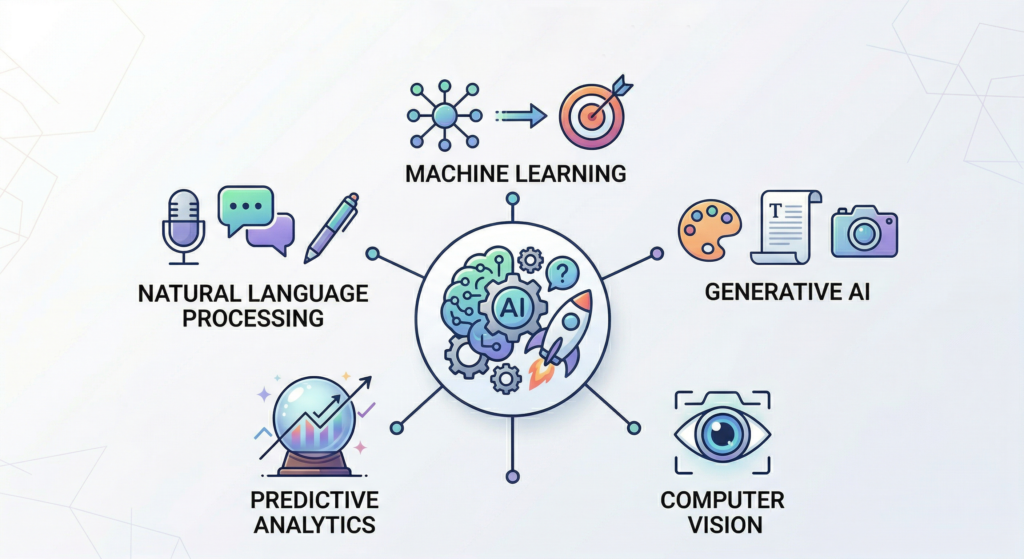
Artificial intelligence in digital marketing is the use of machine learning, natural language processing, predictive analytics, and automation to improve marketing decisions, personalize customer experiences, and scale content creation. In practical terms, it means a chatbot qualifying your leads at 2am, an algorithm predicting which email subject line gets more opens before you even send it, or a content tool that drafts your blog post in seconds.
Key AI Technologies in Marketing
- Machine Learning (ML): Identifies patterns in data to predict behavior, from churn likelihood to next-best-offer recommendations.
- Natural Language Processing (NLP): Powers chatbots, voice search optimization, sentiment analysis, and AI writing tools.
- Generative AI: Creates original text, images, and video at scale, tools like Claude, ChatGPT, and Midjourney are generative AI.
- Computer Vision: Enables visual search, image recognition in social listening, and AI-powered video analysis.
- Predictive Analytics: Forecasts campaign performance, customer lifetime value, and demand trends before they materialize.
2. AI-Powered Content Marketing
Content is the backbone of digital marketing, and the area where AI has made its most visible impact. Over 80% of marketers now report using AI for content creation, including email copy, according to HubSpot’s 2026 State of Generative AI Report. Content creation remains AI’s leading use case, with 55% of AI-using marketers relying on it specifically for text-based output.
AI Writing Tools: Speed Without Sacrifice
Tools like Claude, ChatGPT, Jasper, and Copy.ai can generate blog drafts, email sequences, product descriptions, and social captions in a fraction of the time it takes to write manually. The key is to use AI as a co-creator, not a replacement: AI drafts, you refine, add brand voice, and inject the lived experience no algorithm can replicate. Only 4% of marketers publish AI-generated content with zero edits, and that is the right instinct. The result of this human-AI collaboration: more content, better content, published faster.
AI and the SEO Transformation
SEO is being radically redefined. Half of all Google searches now include an AI overview, and 40.6% of marketers say updating their SEO strategy for AI-powered search is their top priority in 2026, per HubSpot’s 2026 State of Marketing.
Traditional SEO is giving way to AEO and GEO, optimizing content to be cited by AI tools, not just Google. If your content isn’t structured for AI as well as humans, your brand risks losing its voice entirely.
3. AI in Email Marketing & Personalization
Email marketing remains one of the highest-ROI channels in digital marketing, and AI is making it even more powerful. Among marketers using AI for personalization, 91% report that it improves engagement. Meanwhile, 65% of consumers now expect faster and more personalized responses because of their everyday AI experiences, raising the bar for what good email marketing looks like.
AI tools embedded in platforms like HubSpot, Klaviyo, Salesforce Einstein, and Mailchimp analyze subscriber behavior to predict optimal send times, personalize subject lines, recommend products based on browsing history, and automatically re-engage lapsing subscribers, all without manual intervention. The result is true 1-to-1 personalization at scale, something no human team could execute across thousands of subscribers.
4. AI in Paid Advertising & Social Media
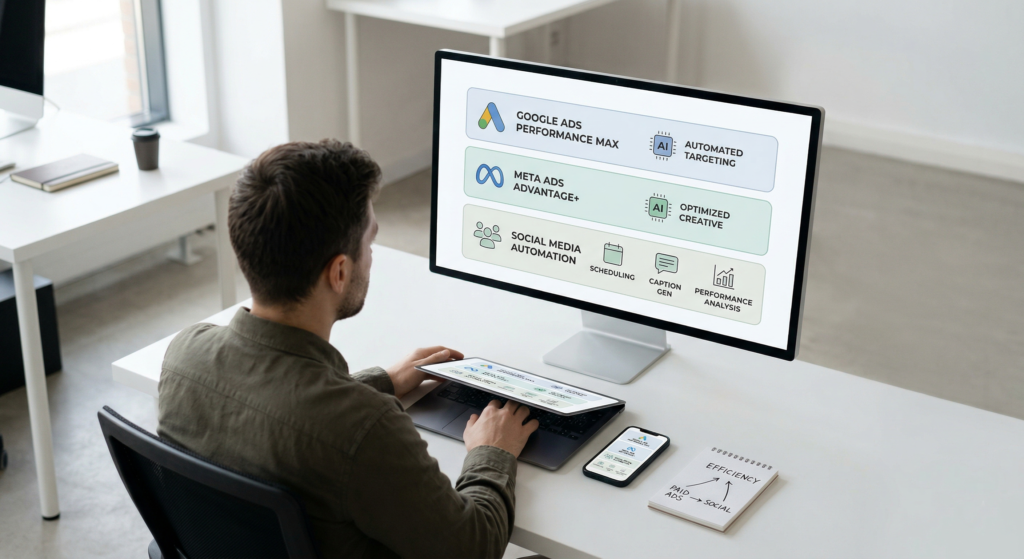
Paid advertising is where AI has made its biggest commercial impact. Platforms like Google Ads and Meta Ads have embedded AI into their bidding algorithms, audience targeting, and creative optimization. Google’s Performance Max campaigns serve ads across all Google channels simultaneously, optimizing in real time. Meta’s Advantage+ Shopping Campaigns do the same for e-commerce brands, dramatically reducing the manual work required to run profitable ads.
On social media, automation is becoming marketers’ most trusted tool: 47% of marketers are now using it to make their processes more efficient, and 71% say they are actively trying to keep pace with how buyers move between platforms and formats. AI-powered scheduling, caption generation, and performance analysis tools are no longer optional extras, they are baseline infrastructure.
AI-Generated Video: The Next Creative Frontier
Short-form video (49%), long-form video (29%), and live streaming (25%) are currently the top three ROI-driving content formats for marketers. AI tools like Runway, Sora, and ElevenLabs are making broadcast-quality video content accessible to small teams without large production budgets, a massive democratization of creative capability that levels the playing field for independent brands and agencies.
5. AI Chatbots & Customer Experience
Customer experience is marketing. And AI chatbots are transforming how brands interact with their audiences around the clock. According to McKinsey, marketing and sales are consistently among the business functions where AI generates the most measurable revenue impact, and contact-center automation is one of the most reported AI use cases across industries.McKinsey’s State of AI 2025 report also highlights that high-performing AI companies, those reporting meaningful bottom-line impact, are significantly more likely to use AI in marketing and sales, have fundamentally redesigned their workflows around AI, and are scaling AI agents across their operations. This is not a coincidence: intentional workflow redesign is one of the strongest predictors of real business impact from AI.
6. AI Tools for Marketers: Where to Start
With hundreds of AI marketing tools on the market, the most important principle is simple: start with the tool that solves your biggest bottleneck, not the flashiest one. Here is a practical breakdown by category:
- Content Writing: Claude, ChatGPT, Jasper, Copy.ai, for blog posts, email copy, social captions, and ad creative.
- SEO & Research: Semrush AI, Surfer SEO, Clearscope, for keyword research, content briefs, and on-page optimization.
- Email & CRM: HubSpot AI, Klaviyo, Salesforce Einstein, for segmentation, automation, and send-time optimization.
- Social Media: Hootsuite AI, Buffer, Lately, for scheduling, caption generation, and performance analysis.
- Ad Optimization: Google Performance Max, Meta Advantage+, Adzooma, for automated bidding and audience targeting.
- Analytics & Insights: Google Analytics 4, Amplitude, Triple Whale, for attribution, forecasting, and customer journey mapping.
- Video & Visual: Runway, Sora, Canva AI, ElevenLabs, for AI-generated video, images, and voiceovers.
🚀 Want to take your AI skills further? Read our companion guide: How to Master Claude Code: From Beginner to Pro. Whether you are a non-technical marketer or a seasoned developer, this guide will show you exactly how to harness Claude Code to save hours and build smarter campaigns.
7. Building Your AI Marketing Strategy
Having access to AI tools is only half the equation. Building a coherent AI marketing strategy is what separates brands that see real ROI from those that simply collect expensive subscriptions.
Step 1: Audit Your Current Stack
Before adding new AI tools, identify where your team loses the most time and where your results are weakest. Map your entire marketing workflow and ask: which of these steps could be automated or enhanced by AI without compromising quality?
Step 2: Start With One Channel
The biggest mistake brands make is trying to implement AI everywhere at once. Pick one high-impact channel, email, content, or paid advertising, and master AI implementation there first. Build internal expertise, measure results, then expand. Controlled focus produces better learning and better ROI than scattered adoption.
Step 3: Close the AI Knowledge Gap
The knowledge gap is the most significant barrier to AI adoption. 39% of marketers say the time and training required to learn new AI tools is their main obstacle. This is why structured learning matters so much. At Mindull Academy, we offer a professional certificate in AI in Digital Marketing, a practical, hands-on programme designed to give marketers the AI fluency they need to compete in 2026. Whether you are just starting to explore AI tools or looking to formalize your expertise, the certificate covers everything from prompt engineering and AI content strategy to data-driven personalization and ethical AI marketing. You walk away with skills you can apply from day one, not theory, but practice.
Step 4: Measure, Iterate, and Scale
AI in marketing is not set-and-forget. Track what matters, conversion rates, cost per acquisition, engagement, and revenue, and use that data to refine your AI implementations continuously. McKinsey’s research shows that AI high performers are more than three times as likely as their peers to have fundamentally redesigned their workflows around AI, and significantly more likely to report meaningful business impact as a result.
The Window Is Open. But Not Forever
AI in digital marketing is not a trend. It is a structural transformation. The competitive advantage belongs to those who move now, build AI fluency into their teams, and deploy it with strategic intent rather than reactive panic. The brands that will thrive are not necessarily those with the biggest budgets, they are the ones curious enough to experiment, disciplined enough to measure, and human enough to remember that at the end of every algorithm, there is a real person who needs to trust you before they buy from you.
AI is your most powerful marketing partner in 2026. Use it wisely, use it boldly, and use it in service of genuinely helping your audience. That is how you win.